

Rethinking "Antisemitism": Mayberg Foundation Trustees Challenge Staff on Terminology to Describe Jew Hatred
/

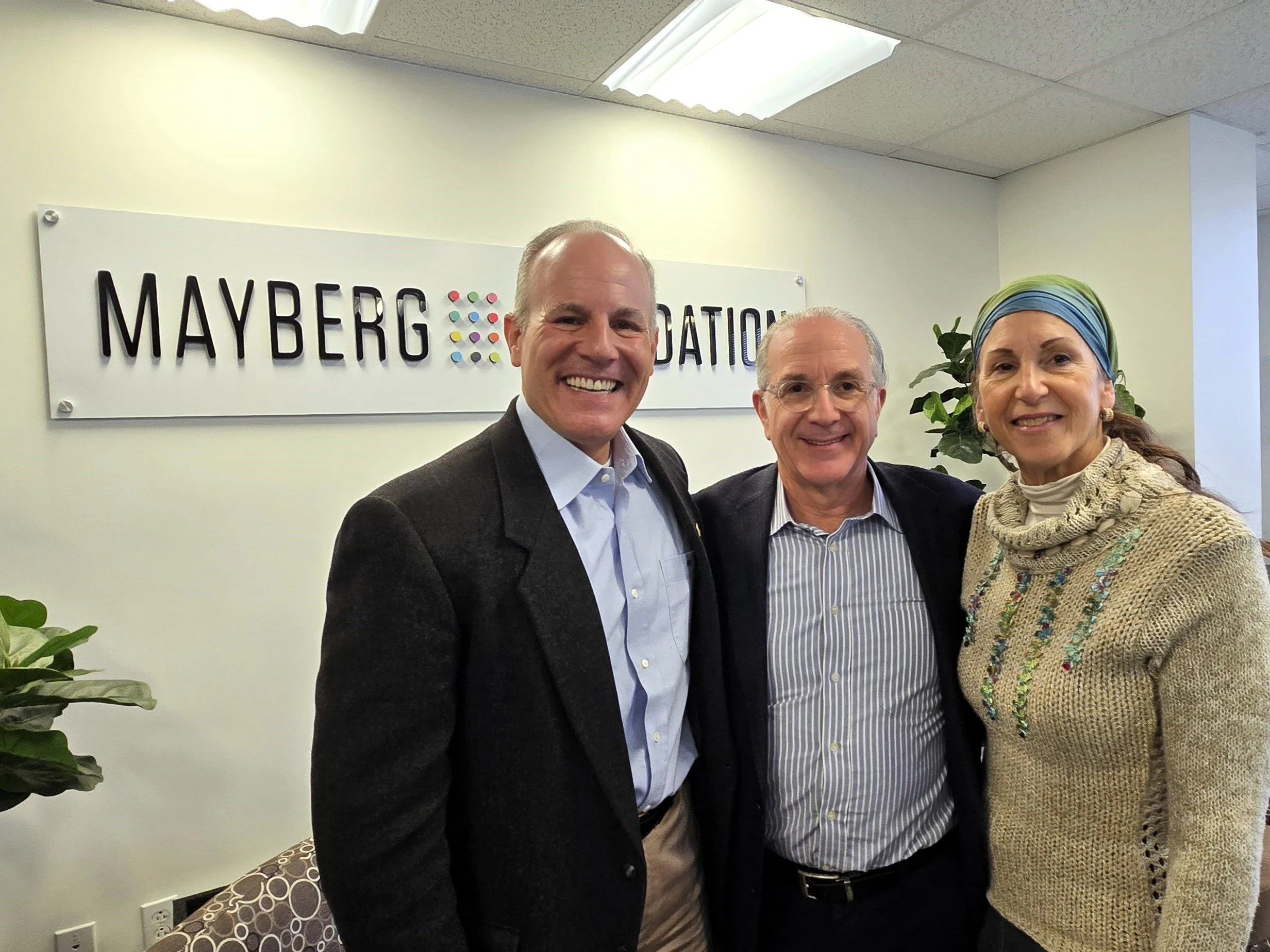

How do we describe the physical and rhetorical violence targeting the global Jewish community right now? Does the term "antisemitism" accurately capture these actions, or is a more explicit term needed?
These are the questions Mayberg Foundation Trustees Manette and Louis Mayberg posed to foundation and preferred partner staff at a special gathering last week. The gathering was prompted by a video Manette received, in which actor and Jewish advocate Jonah Platt implores the Jewish community to use terms like “anti-Jew hate,” “anti-Jewish racism,” and “anti-Jewish bigotry” instead of the term “antisemitism," which he believes is an “antiquated, more polite term” that obfuscates what is really going on around the world.
In a discussion facilitated by former US Special Envoy for Monitoring and Combating Anti-Semitism Elan Carr, the group explored whether, in efforts to best communicate about and combat hatred against Jews, the term "antisemitism" still serves its intended purpose—or whether clearer, more direct language might better capture the urgency of the issue. Carr, the current CEO of the Israeli American Council (IAC), highlighted the fact that the term “antisemitism” is “enshrined in law,” as both federal and state laws use the International Holocaust Remembrance Alliance’s (IHRA) definition, which "captures both traditional and modern forms of Jew hatred, including anti-Zionism." Carr also pointed out that the term “antisemitism” has “an added advantage of emphasizing the ethno-national nature of Jew hatred.”
“Our enemies intentionally reduce us to being nothing more than a culture or a religion at most… This is all very intentional,” he said.
Participants quickly acknowledged a tension: while the term carries legal weight and international recognition, it may not resonate emotionally with broader audiences. As Louis observed, terms like "bigot" and "hater" are "more impactful than 'antisemitism,'” which he finds sanitized.
The group wrestled with practical considerations, noting that major Jewish organizations predominantly use "antisemitism," creating expectations of consistency. Yet there was recognition that the community shouldn't be bound by terminology that fails to communicate effectively. Rather than choosing between competing terms, the group converged on a flexible approach: to rotate language and try different terms to see what resonates most.
The discussion also highlighted that strong Jewish identity and education serve as essential counterweights to hatred, with conversation touching on partnerships with organizations like AEPi to develop joint pro-Israel campus programming. Ultimately, it was decided not to abandon established terms but to expand our vocabulary—using multiple terms interchangeably to emphasize the equivalence of Jew hatred and antisemitism—maintaining legal precision while speaking with moral clarity that confronts hatred and builds Jewish pride and resilience.