

Get to Know our New Managing Director, Operations
/Rob Levine on Operations, Culture, and What Drew Him to Mayberg Foundation
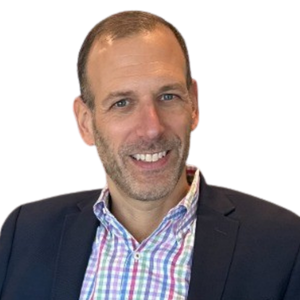
As the Mayberg Foundation's grantmaking and programmatic impact continue to scale, we're building the internal infrastructure to match — bringing the same rigor to our systems that we've always brought to our external partnerships. To support that growth, we expanded our leadership team with a new role, managing director, operations, and Rob Levine recently stepped in to fill it. Below, he shares more about what drew him to the role and how he's thinking about the work ahead.
Tell us a bit about yourself and your family.
Thirty years ago, an AEPi fraternity brother set me up on a blind date with Michele, now my wife and partner in raising our two kids: our daughter Arielle, a junior at the University of Michigan, and our son Aaron, a high school junior. Our family also includes Shepley, a rescue mutt named after Ethan Allen Shepley, a former chancellor at Washington U in St. Louis, where Michele and I both went to school. I'm a Connecticut native, a masters swimmer, and an avid reader of novels.
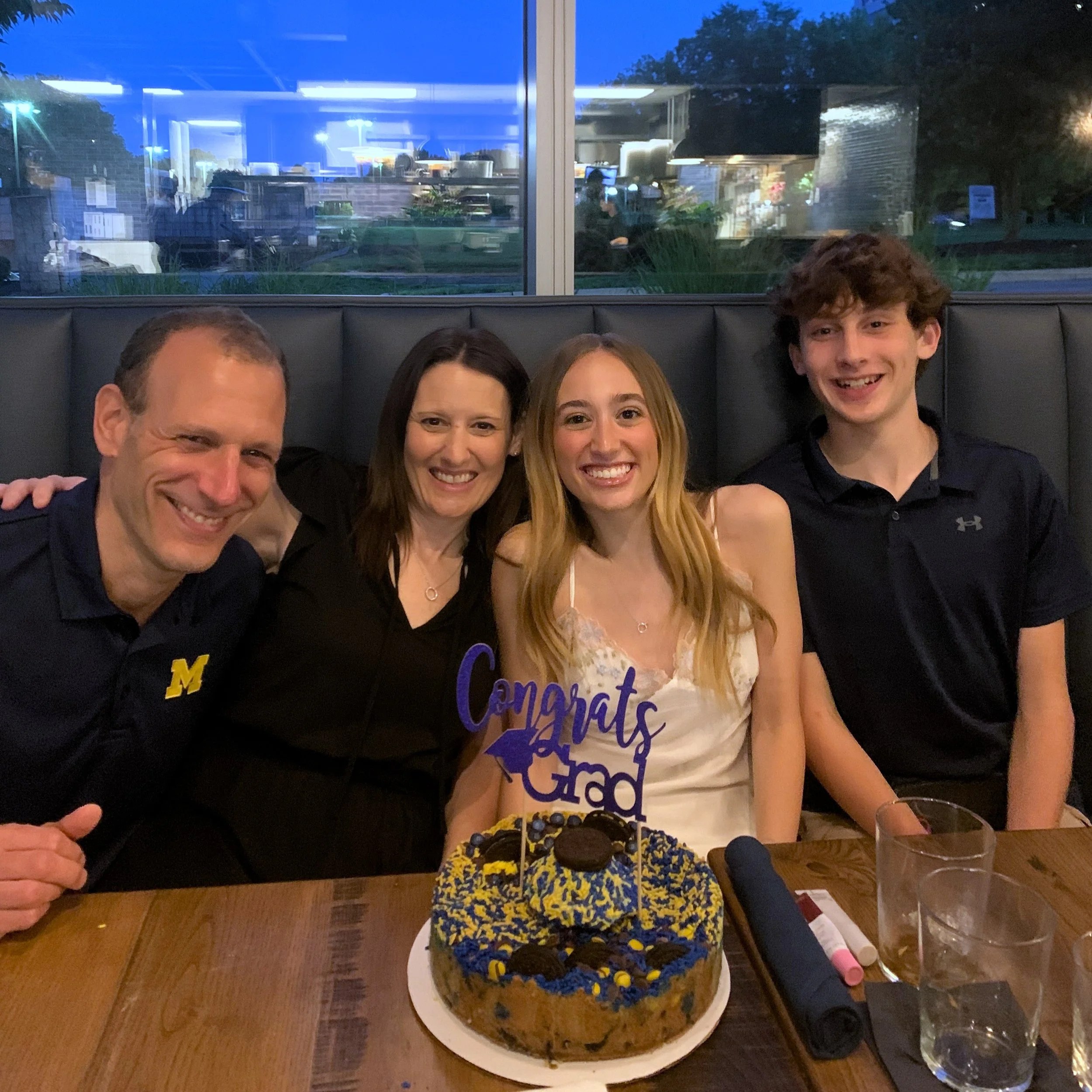
The LEvine family: Rob, Michele, Arielle and Aaron
Let’s talk about your professional path. For more than two decades, you’ve balanced running a business at Marriner Marketing with leading Jewish communal organizations like Bet Yeladim and Temple Isaiah. What does it mean to you personally to see those two worlds come together at the Mayberg Foundation? What specifically inspired you about our foundation’s mission of proliferating Jewish wisdom and values in the contemporary world and strengthening the inner life of every Jew?
I'm part of a Torah study group, and we often look to the text for relevance in the modern world. We talk a lot about the phrase קוֹל דְּמָמָה דַקָּה, “Kol Demamah Dakah,” “a still, small voice.” We all hear it from time to time. What matters is having the discipline and courage to listen to that voice from within.
For years, the voice was telling me to move professionally toward a life of Jewish service, and I ignored it, building my family and my career instead. In early 2026, carrying grief from my father's passing while facing my 50th birthday year, I finally listened. I had my “if not now, then when” moment.
There is so much that inspires me about the foundation's mission. First is the inclusivity referenced in the mission statement. I grew up in a Conservative synagogue, and for years held a fairly rigid, us-and-them view of Judaism. Today, I serve on the Board of Trustees at Temple Isaiah, a Reform congregation — a role that reflects how much my thinking has shifted. With the wisdom of years, I see how counterproductive that earlier view was, especially in a world where a strong, united Jewish community matters more than ever.
There is also something beautiful about “the inner life of every Jew.” I've come to understand that a person's relationship to religion is deeply personal. As award-winning author Peter Orner put it, we are the sum of our contradictions. This is incredibly relevant in how each of us relates to Hashem. Championing that diversity instead of judging it, and offering wisdom and values through a modern lens, is both humble and bold.
How do you think about the relationship between strong operational systems and the kind of deep, strategic work this team does every day?
This was framed well at my welcome lunch, in the words Manette and Louis shared and in Amanda's dvar Torah. Effective Operations is like a snowplow a few miles ahead of you that hums along in the foreground, unnoticed, clearing the way for strategy and execution. Left unchecked, Operations can quickly calcify into policies and procedures for their own sake. The operational function has to be in service of the work, not become an obstacle to it.
Early in my career, moving from an entrepreneurial advertising agency to a multinational public company, one of my first assignments was cutting through months of red tape just to formally discontinue a product we'd stopped selling two years earlier — a distraction at a time when I should have been focused on learning and driving the business. That assignment still sticks with me a quarter century later.
My goal is to get the right input and identify immediate priorities from the team – the true stakeholders – and make sure Operations is advancing and enabling the mission, not getting in its way.
Beyond systems and software, you are partnering with leadership to support our workplace culture. What does a vibrant, mission-focused team culture and environment look like to you? How do you plan to ensure our physical office space and daily workflows reflect the high value the Foundation places on warmth and hospitality?
There's a lot written about office culture, and how it can quickly turn into pizza parties and ping pong tables. Team bonding like that has its place, and look for ways to level it up. But in my early visits to the Foundation's offices, I've felt genuinely welcomed. That isn't happenstance; it is embedded in the culture here.
Will Guidara's book Unreasonable Hospitality talks about the shift that happens when people feel deeply seen and cared for. In many ways, culture comes down to respect – kavod. Are we showing real respect for our teammates' motivations and their boundaries? Are we clear and kind in our expectations of each other? Do we communicate clearly, give effective feedback, and follow through? Those are the behaviors that count and it's on the leaders to both model and foster them.
You have been learning about the Mayberg Foundation’s work and impact. What has been the most energizing or inspiring part of your conversations so far with our team? What is the key message you want to share with our team as you officially start this collaborative journey with us?
Amanda, Hanan, John, and Todd have let me sit in on their regular update meetings all summer. I am incredibly grateful for their patience with my continuous questions and the transparency it afforded me. What's clear to me is that this is a deeply passionate team, backed by trustees who've given them a moonshot charge. Louis was direct with us at our recent lunch: he wants us swinging for home runs, not doubles. The Mayberg Foundation is clearly not content to plod along safely, operating from the same playbook year after year. We are being encouraged to take risks and make a meaningful impact. I love that there's a real spirit of return on investment and return on expectations here, the discipline to measure our impact, adapt, and learn, rather than keep going for the sake of going. It’s a wonderful way of bringing an entrepreneurial mindset to mission-based work.
I have a lot to learn as I come into the Foundation. My priority is to understand from each team member what it takes for them to reach their highest level of impact. My goal is to find ways Operations can eliminate friction and let you operate at your best, individually and collectively.