

Tuning In to Abundance: Finding Purpose and Wholeness in Rabbi David Aaron’s Blessed
/By Yechezkel Gorelik, Kavana Legacy Foundation
In a fast-paced world that frequently measures our worth by external output and personal gain, many of us are left feeling spiritually drained, disconnected, and asking a fundamental question: How do I cultivate a deeply personal, meaningful, and God-centered inner life?
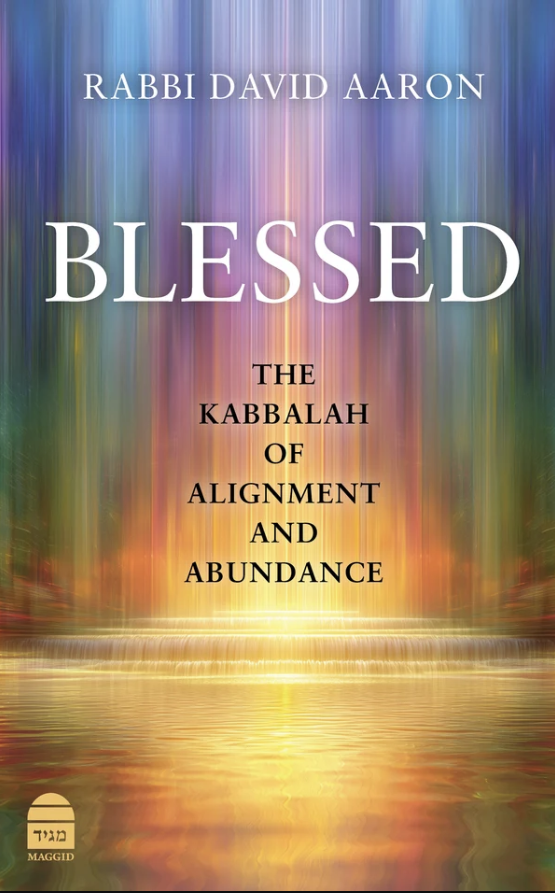
Rabbi David Aaron’s new book, Blessed: Torah Secrets to Finding Fulfillment and Abundance (Maggid Books), is his attempt to answer that question. It draws on the inner dimension of the Torah and turns mystical concepts that can seem out of reach into a practical guide for daily living. The book is the latest project of the Kavana Legacy Foundation, which brings Rabbi Aaron's teaching to a wider audience.
Rabbi Aaron wrote this book because he believes spiritual growth is not reserved for scholars or mystics. Every Jew, whatever their background or level of learning, can build a real and personal relationship with God. At the Kavana Legacy Foundation, we are grateful to the Mayberg Foundation for supporting this work. The Mayberg Foundation shares a conviction at the heart of Rabbi Aaron's teaching: the inner life of every Jew matters and deserves serious attention.
Core Concepts: The Sefirot as Channels for Life
At the heart of Blessed is the concept of the ten sefirot—the divine channels through which God’s presence and blessings flow into our world. Rather than treating these as abstract Kabbalistic diagrams, Rabbi Aaron presents them as daily spiritual powers that shape our consciousness and actions.
Here are three central ideas from the book that can transform how we approach our inner lives:
1. Malkhut (Receptivity): Being an "Enlightened Radio"
The book opens with Malkhut, the power of receptivity. Objective reality is filled with continuous divine goodness, but our subjective mindset determines how much of it we receive.
Rabbi Aaron compares the human soul to a radio. In and of itself, a radio is just a box; its sole purpose is to tune in, receive the broadcast, and play the music. Likewise, when we let go of egotism and recognize that all our talents and energies are gifts from God, we become open channels—transmitting wisdom, kindness, and love to those around us.
2. True Alignment: "God Is His Attributes"
A core principle explored in Blessed is that God does not simply have the qualities of love, truth, or peace—God is love, truth, peace and infinitely more than all the ten sefirot. Bringing God into the world does not require supernatural feats; it means embodying these values in concrete ways. As Rabbi Aaron writes in the book:
"God, as love, doesn't want to remain theoretical, abstract, and ethereal. Love wants to be actualized and made present in this world through a smile, a kind word, a hug."
When we choose to live with integrity, offer comfort, or extend hospitality, we are actively expanding God’s kingdom on earth.
3. Keter (Good Will): Freedom in Higher Connection
The topmost power on the Tree of Life, Keter, represents divine willpower and our deepest human yearning for freedom and transcendence. In the book, Rabbi Aaron challenges the popular notion of freedom. True spiritual freedom is not merely doing whatever our instincts urge us to do in the moment—which often leaves us slave to our moods. Rather, true freedom occurs when we align our individual will with our Higher Self—with God’s good will. Fulfilling the mitzvot (commandments) is not a restrictive burden, but an empowering guide that connects us to our ultimate purpose and shared community.
Cultivating Your Inner Life
Blessed reminds us that spiritual abundance is already present; our task is to remove the barriers of ego, isolation, and self-doubt so we can receive it. By cultivating community consciousness (Knesset Yisrael), practicing active gratitude, and living fully in the present moment, anyone can develop a rich, God-centered inner life.
Availability
Blessed: Torah Secrets to Finding Fulfillment and Abundance is available now. You can order your copy directly from the Koren Publishers website or find it at your local Jewish bookstore.